Showing posts with label share. Show all posts

Wednesday, November 3, 2010

Asian markets remained in positive territory at midday


KUALA LUMPUR: Asian markets remained in positive territory at midday following the Federal Reserve’s latest push to bolster the US economic recovery.

Essentially, the US policymakers – while leaving interest rates unchanged – have stated its intention to purchase a further US$600 billion of longer-term Treasury securities by end of second quarter 2011 in a bid to reduce unemployment and avert deflation.

This is slightly higher than market expectations, which then pushed up key equity indices on Wall Street by between 0.2% and 0.4% at the closing bell.

Analysts expect a lift in sentiment across Asia today following the decision.

“Consequently, the benchmark FBM KLCI will probably show a slight positive bias ahead, making its way towards the resistance target of 1,525,” HwangDBS Vickers Research said in a note.

The FBM KLCI rose 3.07 points to 1,510.67 on Thursday midday trade.

Meanwhile Asian markets were up at midday.

Japan’s Nikkei 225 rose 2.04% to 9,347.23 while Shanghai’s A share index added 1.32% to 3,070,97.

Hong Kong’s Hang Seng index added 1.18% to 24,429.71 and Singapore’s Straits Times Index gained 0.13% to 3,229.21.

At Bursa Malaysia, 372 counters were up, 310 were down while 299 remained unchanged. There were 694.9 million shares done at a total value of RM729.6 million.

Among the top gainers Kulim jumped 58 sen to RM11.88, Boustead rose 21 sen to RM5.83 and Pansar added 16 sen to 66 sen.

QSR rose 19 sen to RM5.50, QL Resources added 15 sen to RM5.76 and Integrax gained 13 sen to RM1.46. Meanwhile, the international reserves report as at Oct 29 – to be out this evening – would give an update on the latest fund flows pattern following a sizeable fortnightly increase of US$4.8bil in the second half of September and US$3.9bil in the first half of October.

In terms of corporate development, UEM Land has offered to buy all Sunrise shares at RM2.80 each via the issuance of new UEM Land shares or redeemable convertible preference shares.

Nymex crude oil was 62 cents higher at US$85.31 per barrel.

The ringgit was quoted at 3.0830 to the US dollar.

Source: http://biz.thestar.com.my/news/story.asp?file=/2010/11/4/business/20101104101822&sec=business

Positive market outlook


PETALING JAYA: Liquidity and a strengthening ringgit are the key forces propelling the FBM Kuala Lumpur Composite Index (FBM KLCI) in the last few months. Now, as concerns of a double-dip recede, along with economic reforms by the Government and the possibility of general elections next year, analysts are becoming more positive on the market’s outlook.

OSK Research Sdn Bhd research head Chris Eng said the outlook for 2011 had improved, with corporate earnings continuing to increase.

“We also have the possibility of the general elections to look forward to. Elections are normally held when the economic prospects are a lot more sound,” said Eng.

He added that the Government had implemented various reforms which seemed to be supportive of the economy and the market as a whole.

On a year-to-date basis, the FBM KLCI was up 18.21% to close yesterday at 1507.60. Over the same period, the ringgit has strengthened close to 10% at approximately 3.087 to the dollar.

Standard & Poor’s Malaysia Sdn Bhd director Alexander Chia said the market was partly being driven by liquidity with the strength of the ringgit a function of this liquidity.

In addition, recent concerns for a double-dip recession had receded somewhat, while positive numbers from China had helped to return confidence to investors.

Markets also got a boost from strong manufacturing figures from China and a general increase in risk appetite ahead of the much-anticipated Federal Reserve meeting yesterday.

China’s Project Management Institute for October came in at 54.7, better than the 53.8 that was expected and the 53.8 in September.

JF Apex Securities Bhd deputy managing director Lim Teck Seng said retailers were starting to return to the market.

“Liquidity is not linked to fundamentals. Eventually fundamentals will dictate,” he said.

“But, for now, there are many people holding cash, and bank lending is relatively easy. Hence, people are putting their money to work through equities and property. The market should be relatively safe over the next six months.”

Lim added that foreigners were coming because Malaysia’s interest rates were moving relatively higher than its regional neighbours.

The overnight policy rate was up by 25 basis points respectively in March, May and July to 2.75%.

“We are positive until the first half of 2011. For the second half of 2011, we will have to look at global numbers,” Eng said, adding that he would turn buyer in December, as he was expecting some correction this month.

“With the continued global quantitive easing, and the slower growth in the West, foreigners realised that there is much better growth here,” he said.

Chia, meanwhile, added that he was buying on dips. He expects more upside for the market in the next six to 12 months.

Tuesday, October 12, 2010

Palm oil stocks grease up FBM KLCI


KUALA LUMPUR: The FTSE Bursa Malaysia KL Composite Index (FBM KLCI) climbed on Wednesday, led by plantation stocks on higher palm oil prices and optimism that the upcoming Budget 2011 to be tabled this Friday may contain additional incentives to lure new investment and boost the economy.

At 9.35am, the benchmark index advanced 5.77 points, or 0.4% to 1,492.34 points. Rising stocks led losers 273 to 88, while 163 counters were unchanged.

“Essentially, amid signs of resilience and with market momentum still on the upside, we reckon the FBM KLCI could be on its way to test the immediate resistance target of 1,495 ahead,’ HwangDBS Vickers said in its morning note.

Palm oil planter Kuala Lumpur-Kepong climbed 14 sen, or 0.8% to RM18.02 - the stock’s highest in more than two years. Rivals IOI Corp rose 9 sen, or 1.6%, while diversified group Sime Darby gained 7 sen, or 0.8% to RM8.83.

Crude palm oil (CPO) futures on Bursa Derivatives settled at RM2,900 a tonne yesterday, a pull back following 6% surged on Tuesday that lifted the benchmark contract to its highest in 26-month high on Tuesday.

Meanwhile, shares in Star Publications was up 24 sen, or 6.4% to RM3.96 after the newspaper publisher announced a special dividend payout of 52.6 sen yesterday.

Overseas, Japan’s Nikkei 225 index surged 1% to 9,486 points, while key indices in Korea, Singapore and Australia were up by 0.6% each.

On Wall Street. the Dow Jones Industrial was up 10 points, or 0.1% to 11,020 points, but the broader S&P 500 Index gained 0.4% to 1,169 points.

Saturday, October 9, 2010

Top Glove: Neutral, target price RM6.06


OSK anticipates that Top Glove's first quarter 2011 outlook will be affected by rising latex prices and the weakening of the US dollar and ringgit


Although financial year 2010 was within expectations, Top Glove Corp's (7113) fourth quarter of the same financial year was affected by unfavourable external factors such as rising latex prices and the weakening of the US dollar and ringgit.

"We anticipate that its first quarter 2011 outlook will not be much different as we think the latex prices and exchange rates will continue to be unfavourable," OSK said.

The research house said this will be offset by the stocking up of activities by its customers.

Top Glove's customers may potentially carry out restocking rather than risk a further hike in selling prices when the rubber trees experience the wintering season, thus causing lower latex production.
On a year-to-date comparison, both the financial year 2010 revenue and net profit were higher by 36 per cent and 45 per cent respectively following the higher sales and produc-tion capacity of examination gloves.


Read more: Top Glove: Neutral, target price RM6.06 http://www.btimes.com.my/Current_News/BTIMES/articles/bvtop/Article/#ixzz11qhDZEJb

Thursday, September 30, 2010

Introduction: KLCI


The Kuala Lumpur Composite Index (KLCI) is a capitalization-weighted stock market index. Introduced in 1986, it is now known as the FTSE Bursa Malaysia KLCI. The enhancements to adopt FTSE Bursa Malaysia Index methodology were implemented on Monday, 6 July 2009.

The FTSE Bursa Malaysia KLCI comprises the largest 30 companies listed on the Malaysian Main Market by full market capitalisation that meet the eligibility requirements of the FTSE Bursa Malaysia Index Ground Rules.
The two main eligibility requirements stated in the FTSE Bursa Malaysia Index Ground Rules are the free float and liquidity requirements as indicated below :-

• Free Float
Each company is required to have a minimum free float of 15%. The free float excludes restricted shareholding like cross holdings, significant long term holdings by founders, their families and/or directors, restricted employee share schemes, government holdings and portfolio investments subject to a lock in clause, for the duration of that clause. A free float factor is applied to the market capitalisation of each company in accordance with the banding specified in the FTSE Bursa Malaysia Ground Rules. The factor is used to determine the attribution of the company’s market activities in the index.

• Liquidity
A liquidity screen is applied to ensure the company’s stocks are liquid enough to be traded. Companies must ensure that at least 10% of their free float adjusted shares in issue is traded in the 12 months prior to an annual index review in December.
It contains 30 companies from the Main Market with approximately 900 to 1000 listed companies. The index has a base value of 100 as of January 2, 1977

Source: http://en.wikipedia.org/wiki/Kuala_Lumpur_Composite_Index

Wednesday, September 29, 2010

Leveraged strategies


Stock that a trader does not actually own may be traded using short selling; margin buying may be used to purchase stock with borrowed funds; or, derivatives may be used to control large blocks of stocks for a much smaller amount of money than would be required by outright purchase or sale.

Short selling

Main article: Short selling
In short selling, the trader borrows stock (usually from his brokerage which holds its clients' shares or its own shares on account to lend to short sellers) then sells it on the market, hoping for the price to fall. The trader eventually buys back the stock, making money if the price fell in the meantime and losing money if it rose. Exiting a short position by buying back the stock is called "covering a short position." This strategy may also be used by unscrupulous traders in illiquid or thinly traded markets to artificially lower the price of a stock. Hence most markets either prevent short selling or place restrictions on when and how a short sale can occur. The practice of naked shorting is illegal in most (but not all) stock markets.

Margin buying

Main article: margin buying


In margin buying, the trader borrows money (at interest) to buy a stock and hopes for it to rise. Most industrialized countries have regulations that require that if the borrowing is based on collateral from other stocks the trader owns outright, it can be a maximum of a certain percentage of those other stocks' value. In the United States, the margin requirements have been 50% for many years (that is, if you want to make a $1000 investment, you need to put up $500, and there is often a maintenance margin below the $500).

A margin call is made if the total value of the investor's account cannot support the loss of the trade. (Upon a decline in the value of the margined securities additional funds may be required to maintain the account's equity, and with or without notice the margined security or any others within the account may be sold by the brokerage to protect its loan position. The investor is responsible for any shortfall following such forced sales.)

Regulation of margin requirements (by the Federal Reserve) was implemented after the Crash of 1929. Before that, speculators typically only needed to put up as little as 10 percent (or even less) of the total investment represented by the stocks purchased. Other rules may include the prohibition of free-riding: putting in an order to buy stocks without paying initially (there is normally a three-day grace period for delivery of the stock), but then selling them (before the three-days are up) and using part of the proceeds to make the original payment (assuming that the value of the stocks has not declined in the interim).

Source: http://en.wikipedia.org/wiki/Stock_market

Importance of Stock Market


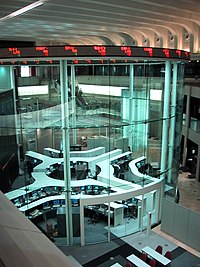
The main trading room of the Tokyo Stock Exchange,where trading is currently completed through computers.


The stock market is one of the most important sources for companies to raise money. This allows businesses to be publicly traded, or raise additional capital for expansion by selling shares of ownership of the company in a public market. The liquidity that an exchange provides affords investors the ability to quickly and easily sell securities. This is an attractive feature of investing in stocks, compared to other less liquid investments such as real estate.

History has shown that the price of shares and other assets is an important part of the dynamics of economic activity, and can influence or be an indicator of social mood. An economy where the stock market is on the rise is considered to be an up-and-coming economy. In fact, the stock market is often considered the primary indicator of a country's economic strength and development.

Rising share prices, for instance, tend to be associated with increased business investment and vice versa. Share prices also affect the wealth of households and their consumption. Therefore, central banks tend to keep an eye on the control and behavior of the stock market and, in general, on the smooth operation of financial system functions. Financial stability is the raison d'être of central banks.
Exchanges also act as the clearinghouse for each transaction, meaning that they collect and deliver the shares, and guarantee payment to the seller of a security. This eliminates the risk to an individual buyer or seller that the counterparty could default on the transaction.

The smooth functioning of all these activities facilitates economic growth in that lower costs and enterprise risks promote the production of goods and services as well as employment. In this way the financial system contributes to increased prosperity.

An important aspect of modern financial markets, however, including the stock markets, is absolute discretion. For example, American stock markets see more unrestrained acceptance of any firm than in smaller markets. For example, Chinese firms that possess little or no perceived value to American society profit American bankers on Wall Street, as they reap large commissions from the placement, as well as the Chinese company which yields funds to invest in China.

However, these companies accrue no intrinsic value to the long-term stability of the American economy, but rather only short-term profits to American business men and the Chinese; although, when the foreign company has a presence in the new market, this can benefit the market's citizens. Conversely, there are very few large foreign corporations listed on the Toronto Stock Exchange TSX, Canada's largest stock exchange. This discretion has insulated Canada to some degree to worldwide financial conditions. In order for the stock markets to truly facilitate economic growth via lower costs and better employment, great attention must be given to the foreign participants being allowed in.

Relation of the stock market to the modern financial system
The financial systems in most western countries has undergone a remarkable transformation. One feature of this development is disintermediation. A portion of the funds involved in saving and financing, flows directly to the financial markets instead of being routed via the traditional bank lending and deposit operations. The general public's heightened interest in investing in the stock market, either directly or through mutual funds, has been an important component of this process.

Statistics show that in recent decades shares have made up an increasingly large proportion of households' financial assets in many countries. In the 1970s, in Sweden, deposit accounts and other very liquid assets with little risk made up almost 60 percent of households' financial wealth, compared to less than 20 percent in the 2000s. The major part of this adjustment in financial portfolios has gone directly to shares but a good deal now takes the form of various kinds of institutional investment for groups of individuals, e.g., pension funds, mutual funds, hedge funds, insurance investment of premiums, etc.

The trend towards forms of saving with a higher risk has been accentuated by new rules for most funds and insurance, permitting a higher proportion of shares to bonds. Similar tendencies are to be found in other industrialized countries. In all developed economic systems, such as the European Union, the United States, Japan and other developed nations, the trend has been the same: saving has moved away from traditional (government insured) bank deposits to more risky securities of one sort or another.

The stock market, individual investors, and financial risk
Riskier long-term saving requires that an individual possess the ability to manage the associated increased risks. Stock prices fluctuate widely, in marked contrast to the stability of (government insured) bank deposits or bonds. This is something that could affect not only the individual investor or household, but also the economy on a large scale. The following deals with some of the risks of the financial sector in general and the stock market in particular. This is certainly more important now that so many newcomers have entered the stock market, or have acquired other 'risky' investments (such as 'investment' property, i.e., real estate and collectables).
With each passing year, the noise level in the stock market rises. Television commentators, financial writers, analysts, and market strategists are all overtaking each other to get investors' attention. At the same time, individual investors, immersed in chat rooms and message boards, are exchanging questionable and often misleading tips. Yet, despite all this available information, investors find it increasingly difficult to profit. Stock prices skyrocket with little reason, then plummet just as quickly, and people who have turned to investing for their children's education and their own retirement become frightened. Sometimes there appears to be no rhyme or reason to the market, only folly.

This is a quote from the preface to a published biography about the long-term value-oriented stock investor Warren Buffett. Buffett began his career with $100, and $100,000 from seven limited partners consisting of Buffett's family and friends. Over the years he has built himself a multi-billion-dollar fortune. The quote illustrates some of what has been happening in the stock market during the end of the 20th century and the beginning of the 21st century.

Source:

Trading


Participants in the stock market range from small individual stock investors to large hedge fund traders, who can be based anywhere. Their orders usually end up with a professional at a stock exchange, who executes the order.

Some exchanges are physical locations where transactions are carried out on a trading floor, by a method known as open outcry. This type of auction is used in stock exchanges and commodity exchanges where traders may enter "verbal" bids and offers simultaneously. The other type of stock exchange is a virtual kind, composed of a network of computers where trades are made electronically via traders.

Actual trades are based on an auction market model where a potential buyer bids a specific price for a stock and a potential seller asks a specific price for the stock. (Buying or selling at market means you will accept any ask price or bid price for the stock, respectively.) When the bid and ask prices match, a sale takes place, on a first-come-first-served basis if there are multiple bidders or askers at a given price.

The purpose of a stock exchange is to facilitate the exchange of securities between buyers and sellers, thus providing a marketplace (virtual or real). The exchanges provide real-time trading information on the listed securities, facilitating price discovery.


The New York Stock Exchange.
The New York Stock Exchange is a physical exchange, also referred to as a listed exchange — only stocks listed with the exchange may be traded. Orders enter by way of exchange members and flow down to a floor broker, who goes to the floor trading post specialist for that stock to trade the order. The specialist's job is to match buy and sell orders using open outcry. If a spread exists, no trade immediately takes place--in this case the specialist should use his/her own resources (money or stock) to close the difference after his/her judged time. Once a trade has been made the details are reported on the "tape" and sent back to the brokerage firm, which then notifies the investor who placed the order. Although there is a significant amount of human contact in this process, computers play an important role, especially for so-called "program trading".

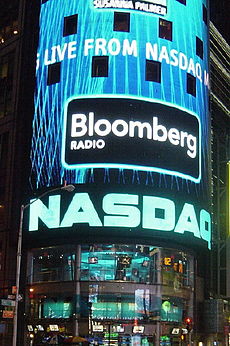
The NASDAQ is a virtual listed exchange, where all of the trading is done over a computer network. The process is similar to the New York Stock Exchange. However, buyers and sellers are electronically matched. One or more NASDAQ market makers will always provide a bid and ask price at which they will always purchase or sell 'their' stock.

The Paris Bourse, now part of Euronext, is an order-driven, electronic stock exchange. It was automated in the late 1980s. Prior to the 1980s, it consisted of an open outcry exchange. Stockbrokers met on the trading floor or the Palais Brongniart. In 1986, the CATS trading system was introduced, and the order matching process was fully automated.

From time to time, active trading (especially in large blocks of securities) have moved away from the 'active' exchanges. Securities firms, led by UBS AG, Goldman Sachs Group Inc. and Credit Suisse Group, already steer 12 percent of U.S. security trades away from the exchanges to their internal systems. That share probably will increase to 18 percent by 2010 as more investment banks bypass the NYSE and NASDAQ and pair buyers and sellers of securities themselves, according to data compiled by Boston-based Aite Group LLC, a brokerage-industry consultant.

Now that computers have eliminated the need for trading floors like the Big Board's, the balance of power in equity markets is shifting. By bringing more orders in-house, where clients can move big blocks of stock anonymously, brokers pay the exchanges less in fees and capture a bigger share of the $11 billion a year that institutional investors pay in trading commissions as well as the surplus of the century had taken place.

Source: Wikipediahttp://en.wikipedia.org/wiki/Stock_market

Stock Market (Share)


A stock market or equity market is a public market (a loose network of economic transactions, not a physical facility or discrete entity) for the trading of company stock (shares) and derivatives at an agreed price; these are securities listed on a stock exchange as well as those only traded privately.

The size of the world stock market was estimated at about $36.6 trillion USD at the beginning of October 2008.The total world derivatives market has been estimated at about $791 trillion face or nominal value, 11 times the size of the entire world economy.The value of the derivatives market, because it is stated in terms of notional values, cannot be directly compared to a stock or a fixed income security, which traditionally refers to an actual value. Moreover, the vast majority of derivatives 'cancel' each other out (i.e., a derivative 'bet' on an event occurring is offset by a comparable derivative 'bet' on the event not occurring).

Many such relatively illiquid securities are valued as marked to model, rather than an actual market price.

The stocks are listed and traded on stock exchanges which are entities of a corporation or mutual organization specialized in the business of bringing buyers and sellers of the organizations to a listing of stocks and securities together. The largest stock market in the United States, by market cap, is the New York Stock Exchange, NYSE. In Canada, the largest stock market is the Toronto Stock Exchange. Major European examples of stock exchanges include the London Stock Exchange, Paris Bourse, and the Deutsche Börse. Asian examples include the Tokyo Stock Exchange, the Hong Kong Stock Exchange, the Shanghai Stock Exchange, and the Bombay Stock Exchange. In Latin America, there are such exchanges as the BM&F Bovespa and the BMV.

Source: http://en.wikipedia.org/wiki/Stock_market